Most pain doesn’t start where you feel it. That’s why pain keeps coming back. You stretch your neck, rub your shoulder, or try to loosen your low back — but the tension returns within hours or days. The problem isn’t effort. It’s location.
This post explains where pain actually starts inside the body, why it spreads to other areas, and how the 3-step reset sequence helps you treat the source instead of chasing symptoms.
Why Pain Starts Somewhere Else
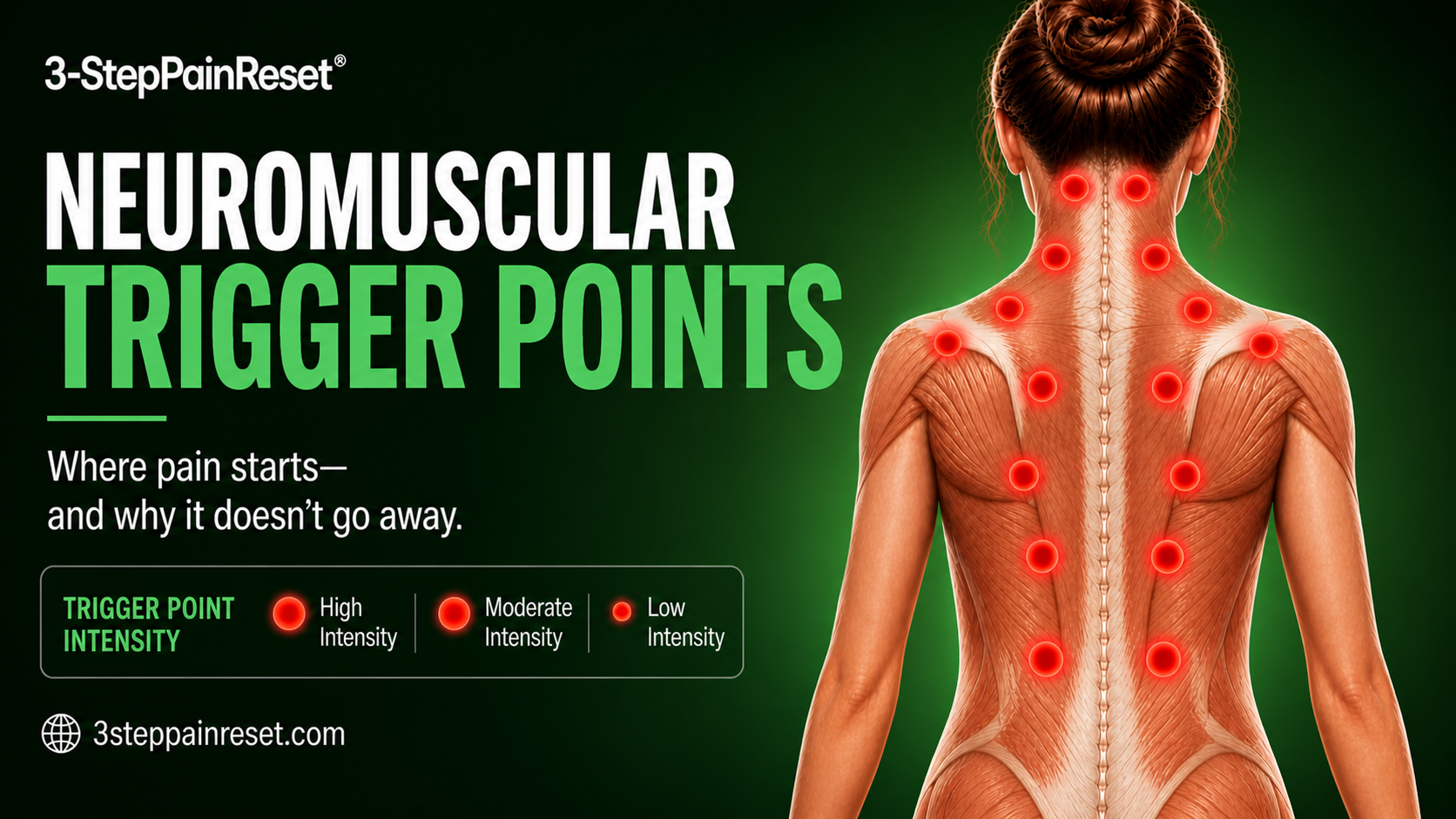
Muscles don’t always hurt where they are tight. Instead, they create what’s called referred pain — a signal sent from a contracted muscle to a different area. This is controlled by the nervous system, not just the tissue itself.
The 3-Step Pain Reset™
Stop treating symptoms. Reset the pattern that keeps creating them.
The same neuromuscular method used in clinical settings — simplified for home use. Release → Moist Heat → Stretch. Done in order. Takes 15–20 minutes.
For example, a tight upper trapezius muscle can send pain into your neck or head. A trigger point in your shoulder blade can feel like deep shoulder joint pain. And a contracted quadratus lumborum (QL) in your low back can create stiffness or aching that feels like spinal pain.
Where Pain Actually Begins
Muscle tightens
Trigger point forms
Signal spreads
Pain felt elsewhere
You treat wrong spot
Pain keeps returning
Common Pain Patterns Most People Misread
These patterns show up every day and are often misunderstood:
Neck Pain
Often starts in upper trap or suboccipitals
Shoulder Pain
Usually comes from scapular trigger points
Low Back Pain
Commonly driven by QL tightness
If this sounds familiar, your pain is likely coming from trigger points — not the area you’ve been treating. The full breakdown of how this works is explained in this guide to trigger points.
Why Pain Doesn’t Go Away
Once a trigger point forms, it doesn’t release on its own. The muscle stays partially contracted, which reduces blood flow and keeps the tissue irritated. Over time, the nervous system adapts to this pattern and treats it as normal.
Most people try to fix this with stretching alone. But stretching a tight, guarded muscle adds stress to tissue that hasn’t released yet — which is why the pain returns quickly.
Why stretching alone fails
A muscle that is still contracted will resist lengthening. Without releasing the trigger point first, stretching reinforces the tension instead of resolving it.
How to Fix Where Pain Actually Starts
To stop pain from returning, you have to treat the source — not the symptom. That means working directly on the trigger point before trying to stretch the muscle.
The Correct Sequence — In This Order
This sequence works because it addresses the nervous system and the muscle tissue in the correct order. Release reduces contraction. Heat increases blood flow. Stretch resets length.
Research from the National Library of Medicine supports that trigger points create referred pain patterns and require direct treatment at the source rather than only addressing the painful area.