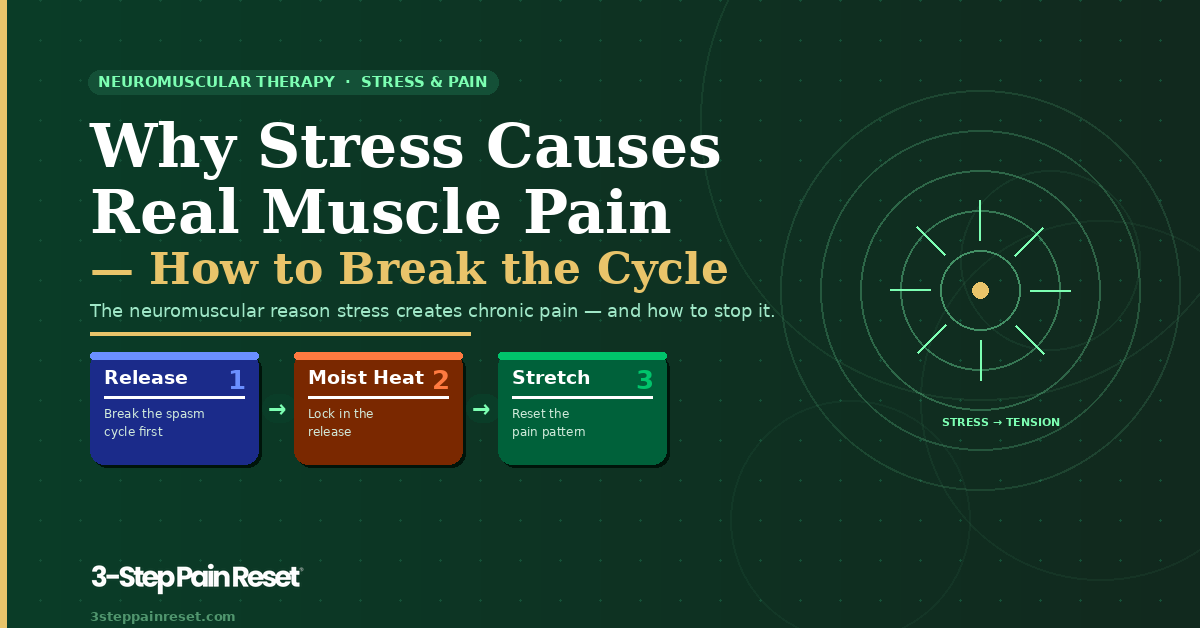
Stress and muscle tension pain are more connected than most people realize. When you feel emotionally stressed, your muscles — especially in your neck, shoulders, and jaw — contract and guard, just like they would protecting you from a physical threat. The problem is that emotional stress never fully resolves the way a physical danger does, so the muscles never fully let go. That’s why stress-driven pain keeps coming back and becomes chronic, even when there’s no injury to explain the pain.
This post explains the neuromuscular reason stress keeps your body physically tight, which muscles are affected first, and how the 3-step reset sequence helps interrupt the cycle at the tissue level.
Why Emotional Stress Creates Physical Muscle Tightness
The nervous system does not distinguish between emotional and physical threats. When stress arrives — a deadline, a difficult conversation, financial pressure — the sympathetic nervous system activates and sends a signal to your muscles: brace. The upper trapezius contracts. The suboccipitals at the base of your skull tighten. The jaw closes slightly. Your shoulders rise toward your ears.
The 3-Step Pain Reset™
Stop treating symptoms. Reset the pattern that keeps creating them.
The same neuromuscular method used in clinical settings — simplified for home use. Release → Moist Heat → Stretch. Done in order. Takes 15–20 minutes.
This is a protective guarding response — the same one that would help you dodge a falling object. The difference is that a physical threat resolves in seconds. Stress and muscle tension pain from emotional sources can persist for hours, days, or weeks because the stressor never fully clears.
The Sympathetic Loop
Stress signal
Brain perceives threat
Muscles brace
Upper trap, neck, jaw contract
Pain develops
Tension becomes chronic
Which Muscles Are Hit First by Stress
Three muscle groups respond to stress and muscle tension before any others:
Upper Trapezius
Neck, shoulder blade pain — refers to the head and temple
Suboccipitals
Base of skull — tension headaches, neck stiffness on waking
Masseter / Jaw
Jaw clenching — radiates to ear, temple, and neck
These three are interconnected. The upper trap feeds into the suboccipital group. The suboccipitals connect to the jaw and base of skull. When stress and muscle tension activate all three together, the pain pattern spreads — which is why your pain keeps moving to new spots even when you treat one area at a time.
How Stress and Muscle Tension Become a Permanent Loop
The longer muscles stay contracted, the more the tissue changes. Sustained tension reduces blood flow to the area, which causes local oxygen deprivation — that creates a dull ache and makes the muscle hypersensitive to pressure. Trigger points form inside the muscle fibers as knotted, contracted bands that won’t let go on their own.
Then the pain itself becomes a secondary stressor. You hurt, which creates more anxiety, which keeps the sympathetic nervous system activated, which keeps the muscles bracing. This is why stress-driven pain is so difficult to stretch or push through — the most common approach to fixing muscle pain often makes it worse when stress is the driver.
Why stretching alone doesn’t fix stress-driven tension
Stretching a muscle that is guarding due to nervous system activation adds load to a tissue that is already resisting. The muscle senses the pull as a threat and contracts further. You need to interrupt the contraction first — then lengthen the tissue.
How the 3-Step Reset Interrupts the Stress-Pain Cycle
The reason the release-first sequence works on stress-driven pain is that sustained gentle pressure on a trigger point interrupts the sympathetic signal locally. The pressure communicates safety to the nervous system at the tissue level — the muscle can’t maintain the brace response while receiving consistent, non-threatening input.
The Correct Sequence — In This Order
Release first — use a massage ball or thumbsaver on the upper trap, base of skull, or jaw. Gentle sustained pressure 30–60 seconds per spot. This is what interrupts the sympathetic guarding signal.
Moist heat second — apply heat to the released area for 10–15 minutes. Moist heat activates the parasympathetic nervous system — the exact opposite of the stress response. This is what deepens the release and holds it.
Stretch last — only now does the muscle respond to lengthening without guarding. Slow ear-to-shoulder holds, chin tucks, and cross-body stretches for the upper trap. Each one resets the resting length the stress shortened.
What to Use for the Release Step on Stress Muscles
The upper trap and suboccipital muscles are difficult to reach with your own hands and almost impossible to hold pressure on for 30–60 seconds without fatiguing. The right tool makes the difference. See the full list of recommended at-home therapy tools — specifically the Theracane and suboccipital release balls for this pattern.
Tip for jaw and suboccipital work
Lay flat on your back with a small release ball under the base of your skull — gravity does the work. Hold 60 seconds per side. Do this before the moist heat, not after. The horizontal position also shifts your nervous system toward parasympathetic (rest) mode which amplifies the release.
How to Tell If Stress Is Driving Your Muscle Pain
Stress and muscle tension pain has a distinct pattern. It tends to be worse at the end of a difficult day than in the morning — the opposite of most injury-based pain. It often affects both sides of the neck or both shoulders symmetrically. It frequently coincides with headaches that start at the base of the skull and move forward. And it typically gets worse during high-pressure periods at work or at home, even when you haven’t changed your physical activity.
If this matches your pattern, the full guide to identifying muscle tightness vs. other causes can help you confirm the source before starting the reset sequence.
Research published by the American Psychological Association confirms that stress causes measurable muscle tension, particularly in the neck and shoulders, and that chronic stress leads to chronic musculoskeletal pain conditions — validating the neuromuscular approach to treating this pattern at the tissue level rather than only addressing the stress itself.
Related Posts
Morning Pain
Why You Wake Up in Pain Every Morning
The neuromuscular reason overnight rest makes pain worse →
Referred Pain
Why Your Pain Keeps Moving to New Spots
Compensation patterns explained →
Common Mistakes
The 3 Biggest Mistakes Fixing Muscle Pain at Home
Why your usual approach keeps failing →
Identify Your Pain
Is It Muscle Tightness or Something Else?
Know what you’re dealing with before you treat →
At-Home Tools
Release tools for neck, shoulder & jaw
Theracane · massage balls · suboccipital releases