Why Your Pain Won’t Go Away — And What Actually Fixes It
If rest, stretching, medication, or even physical therapy haven’t solved it, there’s a reason. Most persistent pain is a neuromuscular pattern problem — not a structural one.
📍 Serving Phoenix, Scottsdale, Tempe, Mesa, Glendale & all of Arizona · Online programs available nationwide across the USA
You’re not imagining it. And it’s not “just in your head.”
You’ve done everything right. You rested. You took the anti-inflammatories. You tried the stretches your doctor showed you. Maybe you even went through a round of physical therapy. And yet — weeks, months, sometimes years later — the pain is still there. Tight. Achy. Flaring up at the worst times. Refusing to leave.
This is one of the most frustrating experiences a person can have, and it’s far more common than most healthcare providers acknowledge. In the Phoenix and Scottsdale area alone, thousands of people are cycling through pain management appointments, chiropractic adjustments, and prescription refills — without ever being told the actual reason their pain keeps coming back.
The reason, in most cases, is this: the muscle and nervous system pattern that created the pain was never reset. The injury healed. The inflammation resolved. But the neuromuscular holding pattern it triggered — the way your brain is still telling those muscles to guard, brace, and protect — never turned off.
That is a neuromuscular problem. And it requires a neuromuscular solution.
Does This Sound Like You?
Persistent pain that doesn’t respond to standard treatment usually shows up in recognizable patterns. See if any of these match what you’re experiencing:
Pain That Keeps Coming Back
It gets better for a few days or weeks, then returns to the same spot — often worse than before.
Pain That Travels or Spreads
Started in your lower back, now it’s in your hip. Or your neck pain is causing headaches and shoulder tension.
Pain That Wakes You Up
Muscle spasms, stiffness, or deep aching that disrupts sleep — despite trying pillows, positions, and muscle relaxers.
Normal Scans, Ongoing Pain
MRI and X-rays came back “fine” or “age-appropriate” but you are clearly not fine. The pain is real.
Muscle Tightness That Won’t Release
You’ve stretched, foam rolled, had massages — and within hours it’s back to the same level of tension.
Fatigue, Brain Fog, or Low Mood
Chronic pain depletes your nervous system. Cognitive and emotional symptoms often travel alongside the physical ones.
If two or more of those describe your experience, you’re almost certainly dealing with a neuromuscular pattern — not a structural injury that simply hasn’t healed. The distinction matters enormously, because the treatment approach is completely different.
3 Reasons Chronic Pain Refuses to Go Away
Trigger Points — The Hidden Pain Generators
A trigger point is a hyperirritable knot of contracted muscle fibers that cannot release on their own. They form in response to overuse, injury, poor posture, or stress — and they don’t go away with general massage or stretching. What makes them insidious is that they refer pain to other areas of the body, often far from where the trigger point actually lives. Your “shoulder pain” may be generated by a trigger point in your neck. Your “knee pain” may come from your hip. This is why standard treatments so often miss the mark — they treat where it hurts, not where the problem originates.
Neuromuscular Holding Patterns — Your Brain Won’t Let Go
After an injury or period of intense pain, your nervous system creates a protective holding pattern — a habitual way of bracing, guarding, or compensating that felt necessary at the time. The problem is that the nervous system is extremely efficient. Once it learns a pattern, it keeps running it automatically — even after the original injury has resolved. This is called neuromuscular dysfunction, and it’s one of the most commonly overlooked causes of chronic back pain, neck pain, and muscle spasm in both Phoenix patients and people across the country. Neuromuscular re-education (CPT 97112) is the clinical process of retraining these patterns at the source.
Ischemia — Muscles Starved of Blood Flow
When a muscle stays contracted due to a trigger point or holding pattern, it compresses the local blood vessels. This cuts off the oxygen and nutrient supply the muscle needs to recover — a state called ischemia. An ischemic muscle produces lactic acid, generates pain signals, and cannot relax. This is the mechanism behind the deep, burning ache that never fully resolves. Restoring circulation through targeted neuromuscular therapy breaks this cycle by releasing the contraction, restoring blood flow, and allowing the tissue to actually heal.
💡 The 3-Step Pain Reset program was developed around exactly these three mechanisms — trigger point release, neuromuscular re-education, and circulation restoration — using techniques refined over 15 years of clinical practice. See the program + Letter of Medical Necessity bundle →
Pain conditions that respond well to neuromuscular therapy
These are among the most common diagnoses we work with — both in direct sessions in the Phoenix area and through the online 3-Step Pain Reset program available across the USA. Each of these conditions has established ICD-10 codes that support a Letter of Medical Necessity (LMN) for HSA or FSA reimbursement.
This page is educational in nature. Not all conditions listed are guaranteed to respond to neuromuscular therapy. Results vary by individual. Consult your physician regarding your specific diagnosis.
What the 3-Step Pain Reset Actually Does
Developed from 15 years of neuromuscular therapy clinical practice, the 3-Step Pain Reset is a systematic approach to breaking the pain cycle — not masking it. It works whether you’re in Phoenix seeing us directly or working through the program from anywhere in the USA.
Identify the Source
Find the actual trigger points and neuromuscular patterns driving the pain — not just where the pain is felt, but where it originates. Includes body mapping and postural assessment.
Release & Reset
Apply targeted neuromuscular techniques to deactivate trigger points, restore circulation to ischemic tissue, and interrupt the chronic holding pattern. This is where the shift happens.
Re-educate & Stabilize
Retrain the nervous system to move and hold tension differently so the pain pattern doesn’t re-establish. Neuromuscular re-education (CPT 97112) is the clinical term for this critical final step.
Neuromuscular Therapy in Phoenix, AZ — and Online Across the USA
The Phoenix and Scottsdale area has a strong and growing community of people dealing with chronic pain — whether from the physical demands of outdoor activity in the desert heat, desk-bound work in the Valley’s booming tech and finance sectors, or simply years of unresolved musculoskeletal dysfunction that standard healthcare has been unable to fix.
📍 In-Person Sessions — Phoenix, AZ Metro
With 15 years of clinical neuromuscular therapy experience, direct one-on-one sessions are available for Phoenix, Scottsdale, Tempe, Mesa, Chandler, Gilbert, and surrounding Valley communities. Sessions are scheduled personally via email — not through an automated booking system — to ensure your specific case gets the attention it requires before we ever meet.
To inquire about in-person availability in the Phoenix metro area, email us at support@3steppainreset.com. Session fees are HSA and FSA eligible with a valid Letter of Medical Necessity (LMN) from your physician.
🌐 Online Program — Available Nationwide (USA)
The 3-Step Pain Reset program was built specifically for people who can’t access quality neuromuscular therapy locally — or who want a proven at-home system they can work through on their own schedule. The 10-page program guide delivers the same clinical framework used in direct sessions, structured for self-application. Available to anyone in the United States.
The Essential Bundle ($29) includes the program guide plus a physician-ready Letter of Medical Necessity (LMN) template — the document your HSA, FSA, or supplemental insurance plan may require to recognize your therapy as a covered medical expense.
View the program bundle →Can I Use My HSA or FSA for Neuromuscular Therapy?
In many cases, yes — with the right documentation. The IRS (Publication 502) allows HSA and FSA funds to be used for medical expenses that treat a specific diagnosed condition. Neuromuscular therapy, when prescribed for a diagnosis like chronic low back pain (M54.5), cervicalgia (M54.2), or muscle spasm (M62.838), can qualify as a reimbursable medical expense.
The document that establishes this eligibility is called a Letter of Medical Necessity (LMN) — a formal letter signed by your treating physician that confirms your therapy is medically necessary for your specific diagnosis, not general wellness. Many HSA plans are self-directed, meaning you keep the LMN on file for audit purposes. FSA plans may require pre-approval.
The 3-Step Pain Reset Essential Bundle includes a physician-ready, fillable LMN template specifically designed for neuromuscular therapy claims — pre-loaded with relevant ICD-10 and CPT codes to make the physician sign-off process as straightforward as possible.
⚠ Important: An LMN does not guarantee payment or reimbursement from any plan. Eligibility is determined by your individual HSA/FSA plan administrator. Always verify coverage before submitting. All sales of digital products and sessions are final. Learn more about the LMN bundle →
Questions about neuromuscular therapy & chronic pain
How is neuromuscular therapy different from regular massage?
Regular massage works broadly on muscle tension and relaxation. Neuromuscular therapy (NMT) is a clinical approach that targets specific trigger points, nerve compression sites, postural distortions, and ischemic tissue using precise, protocol-driven techniques. Where massage provides temporary relief, properly applied neuromuscular therapy aims to identify and address the root cause of why the muscle is holding tension in the first place — and retrain the nervous system to stop recreating it.
Why does my pain keep coming back after physical therapy?
Physical therapy is excellent for rehabilitation after injury or surgery. However, it primarily addresses movement mechanics, strength, and range of motion. It doesn’t always address the neuromuscular holding patterns and active trigger points that are driving the pain independently of structural damage. Many people complete PT and feel temporarily better — but the underlying pain generator was never deactivated, so the pain returns once the exercises stop.
My MRI showed nothing. Does that mean my pain isn’t real?
Absolutely not. MRIs and X-rays show bones, discs, and gross tissue — they do not image trigger points, neuromuscular dysfunction, or ischemic muscle tissue. It is extremely common for patients with significant, debilitating chronic pain to have “clean” imaging. In fact, a normal MRI alongside persistent pain is one of the clearest indicators that the problem is neuromuscular in origin rather than structural.
Is the 3-Step Pain Reset program right for me if I’m not in Phoenix?
Yes — the online program was built specifically for remote use. The 10-page program guide delivers the full clinical framework in a self-guided format. The Live Session Bundle also supports remote video sessions, available to anyone in the USA regardless of location. Direct in-person sessions are currently available in the Phoenix, Arizona metro area only.
How long does it take to see results?
This varies significantly based on how long the pattern has been established, the specific conditions involved, and how consistently the protocol is applied. Some people experience meaningful relief within the first 1–3 sessions or within the first week of working through the program. Longer-standing chronic patterns — those that have been present for years — typically require more consistent application over 4–8 weeks to achieve durable results. The goal is always lasting change, not temporary relief.
What You’ll Receive
Everything you need — delivered instantly
Both files unlock immediately after purchase. The Letter of Medical Necessity (LMN) is ready for your doctor to sign. The guide is ready to start today.
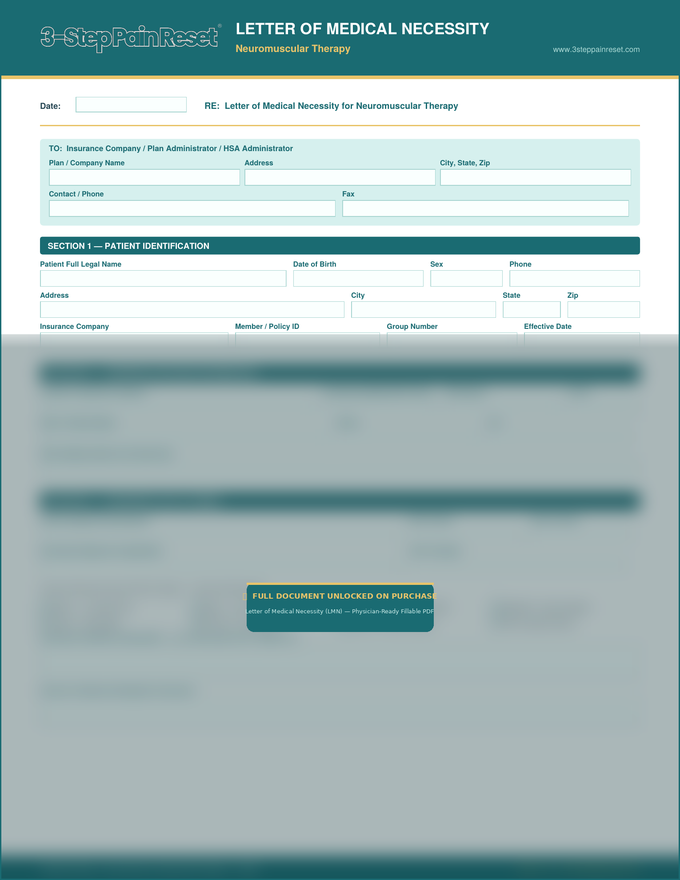
Letter of Medical Necessity (LMN)
Physician-ready fillable PDF
3-Step Pain Reset Guide
10-page at-home protocol
Ready to Actually Fix It?
The 3-Step Pain Reset program gives you the clinical tools, the at-home protocol, and the Letter of Medical Necessity (LMN) your HSA or FSA may require — all in one bundle.