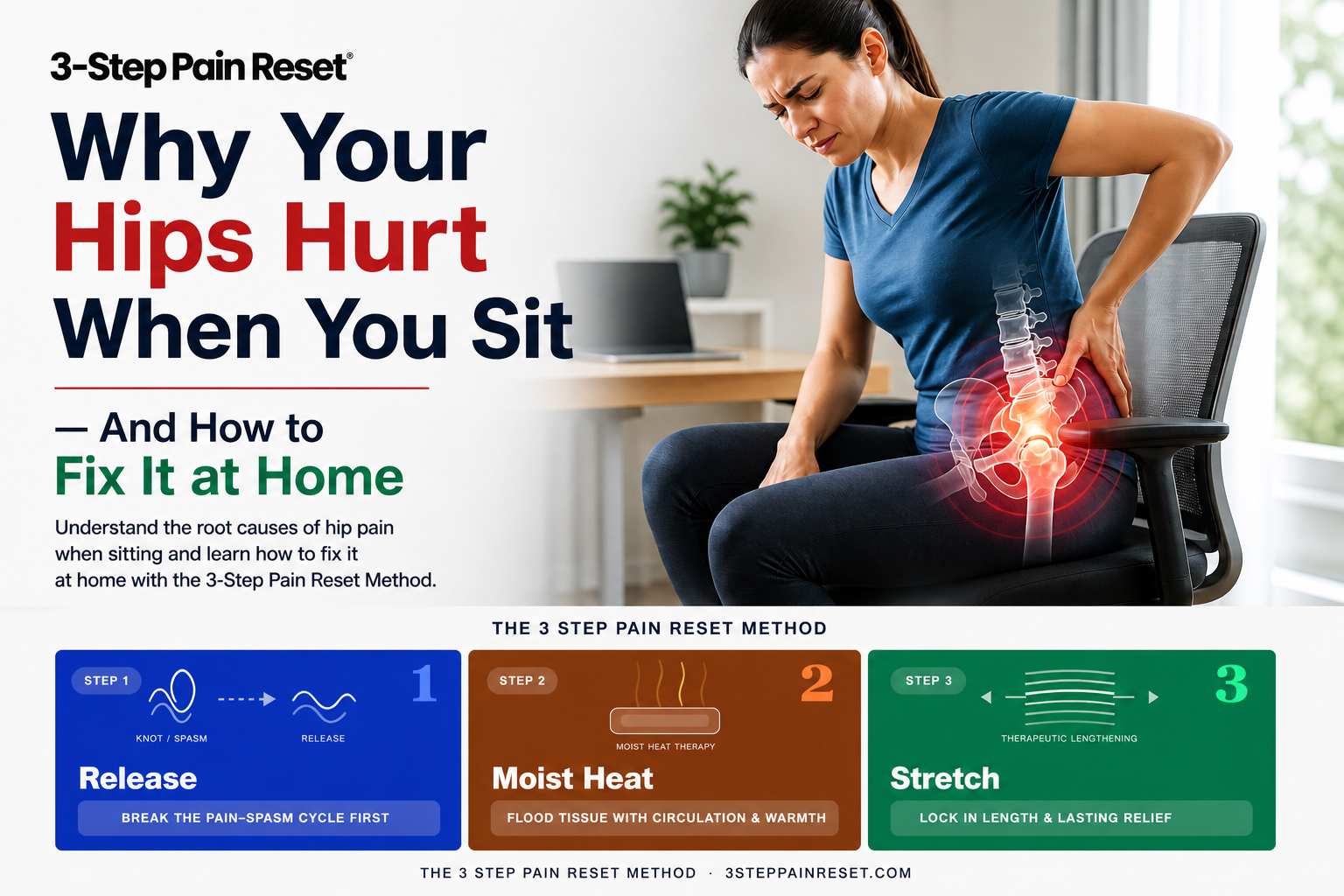
Most people assume hip pain means a hip problem. It usually doesn’t.
If your hips ache after sitting in a chair for 20 minutes, stiffen up when you stand, or feel tight and sore through the buttocks and upper thigh — the cause is almost always muscle tension, not joint damage. And the muscles involved are ones most people have never thought about.
Here’s what’s actually going on, and how to release it at home using the same method that works for neck, shoulder, and low back pain.
The 3-Step Pain Reset™
Stop treating symptoms. Reset the pattern that keeps creating them.
The same neuromuscular method used in clinical settings — simplified for home use. Release → Moist Heat → Stretch. Done in order. Takes 15–20 minutes.
Why Sitting Causes Hip Pain
When you sit, your hip flexors — a group of muscles running from your lower spine down through the front of your hip — stay in a shortened, contracted position for extended periods. At the same time, the muscles in your glutes and deep hip rotators stay under constant compression and pressure from the chair.
Held in that position long enough, these muscles stop cycling the way they should. They get stuck in a partial contraction — the same thing that happens in your neck and shoulders when you’ve been tense for too long.
The result is a band of tissue that won’t let go. It causes pain that keeps coming back, limits movement, and can even send pressure down the leg that people mistake for a nerve problem.
This is a neuromuscular problem — not a structural one. The joint is usually fine. The muscle is not.
How Hip Pain Builds From Sitting
The Piriformis: The Muscle Most People Miss
Deep inside your buttock sits a small but powerful muscle called the piriformis. Its job is to rotate the hip and stabilize the leg during movement.
When the piriformis becomes overloaded — from prolonged sitting, compensating for low back tension, or simply from lack of movement — it locks up. Because the sciatic nerve runs close to this muscle, a tight piriformis can create pain that feels like nerve pain: burning, aching, or a deep soreness that travels down toward the knee.
This is commonly called piriformis syndrome, and it’s widely underdiagnosed — especially in adults over 60 who are told the pain must be coming from their spine or hip joint.
The 3-Step Pain Reset™
Stop treating symptoms. Reset the pattern that keeps creating them.
The same neuromuscular method used in clinical settings — simplified for home use. Release → Moist Heat → Stretch. Done in order. Takes 15–20 minutes.
The Hip Flexors: The Muscle That Pulls Everything Forward
When the hip flexors stay shortened from sitting, they pull your pelvis into a forward tilt. This shifts extra weight into your low back, changes how your glutes engage, and sets off a chain of compensation that can affect your knees, your posture, and how much pain you feel by the end of the day.
Stretching the hip flexors is commonly recommended — and it has its place. But if you stretch before you release the tension that’s locked in, you’ll feel temporary relief at best. The muscle returns to its contracted state within hours.
The right sequence matters — every time.
Hip Flexors
Shorten from sitting, tilt the pelvis, load the low back
Piriformis
Locks under pressure, can mimic nerve pain down the leg
Glute Medius
Weakens from disuse, causes hip instability and side pain
Why Stretching Alone Doesn’t Fix Hip Pain
A muscle that is still contracted will resist lengthening. Without releasing the trigger point first, stretching reinforces the tension instead of resolving it. You may feel a brief release — then the tightness comes back within a few hours.
Why stretching the hip flexor alone fails
When the piriformis and hip flexors are locked in a guarding state, passive stretching pulls on tissue that hasn’t released yet. The nervous system interprets that as a threat and contracts harder — which is exactly why the pain keeps coming back after you stretch.
The 3-Step Approach for Hip and Glute Pain
The same method that works for neck and shoulder tension applies directly to hip pain — because the problem is the same kind of problem. The sequence has to be done in order.
The Correct Sequence — In This Order
Release
Firm pressure on tender spots in the glute and hip. Hold until the tissue softens — don’t force it.
Moist Heat
Moist heat pack on the hip and glute for 15–20 minutes. Improves circulation, helps the muscle fully let go.
Stretch
A gentle kneeling lunge or seated figure-four stretch, held 30–45 seconds. The muscle is now ready to lengthen.
This sequence takes about 25–30 minutes and can be done in a chair, on the floor, or on a bed depending on your mobility. The full area breakdown — including hip flexors, piriformis, and glutes — is in the program guide.
When to Be Concerned
Hip pain that is neuromuscular in origin typically:
- Gets worse after sitting and improves with gentle movement
- Feels dull, tight, or achy rather than sharp or electric
- Shifts slightly from day to day or side to side
- Doesn’t follow a pattern of getting steadily worse over time
If your pain is sharp, came on suddenly after a fall, or is accompanied by weakness in the leg, get it evaluated by a physician before starting any home routine. Those signs suggest something beyond muscle tightness.
What This Feels Like to Treat
Many people are surprised by how much relief comes from a single 25-minute home session targeting the hip and glute specifically. Not because the method is complicated — it isn’t. But because most people have been working on the wrong spot for years.
The hips hold a lot of tension silently. By the time you feel it in the chair, the muscles have often been guarding for weeks. When you release that tension using the right sequence — and do it consistently — most people notice a real difference within a few sessions.
Research from the National Library of Medicine confirms that trigger points create referred pain patterns and require direct treatment at the source rather than only addressing the painful area — and the hip region is no exception.