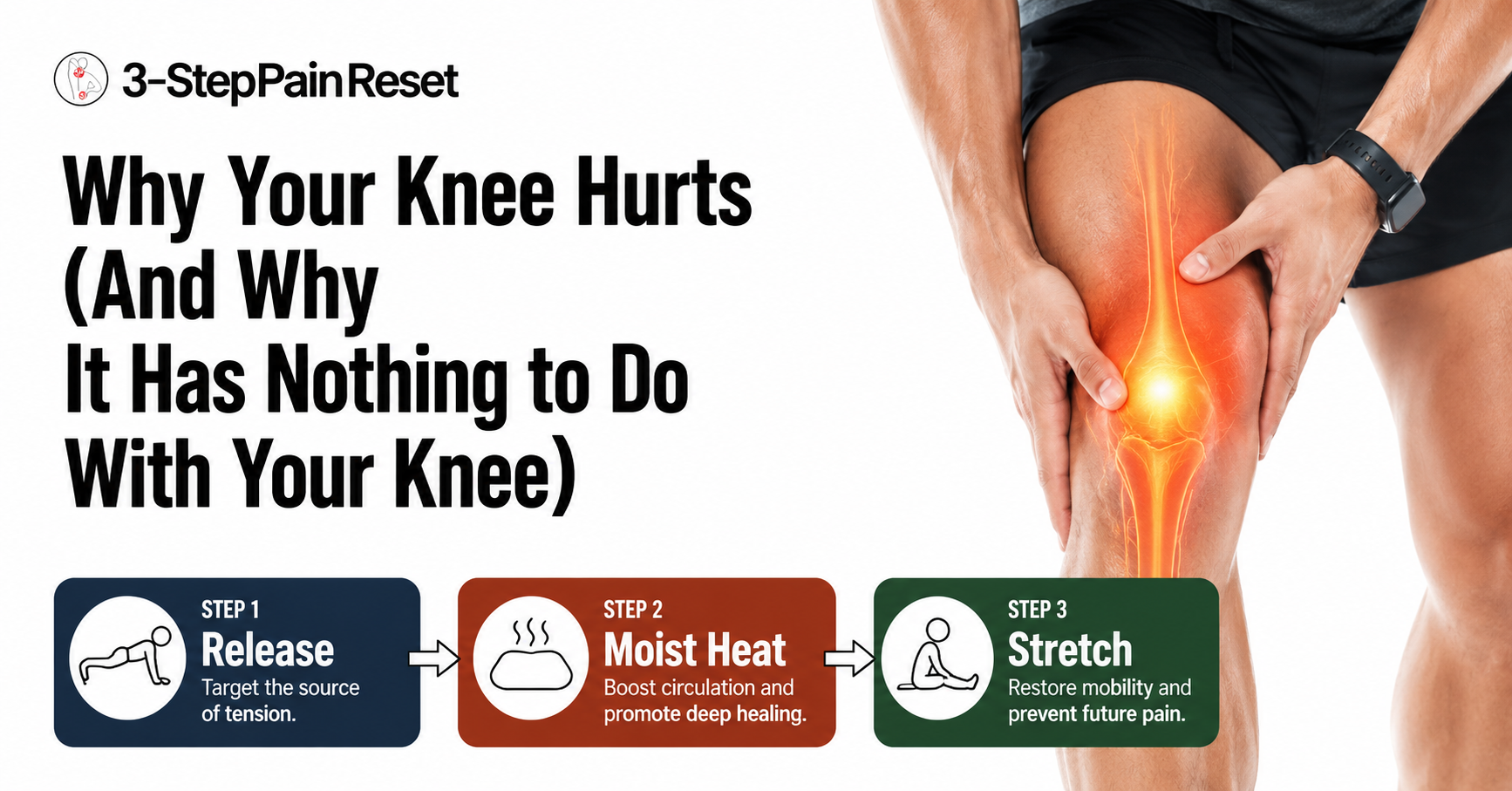
Why Your Knee Hurts (And Why It Has Nothing to Do With Your Knee)
If you have knee pain trigger points driving that familiar ache — the one that comes on when you stand up, walk down stairs, or sit too long — the problem may not be in your knee at all.
The knee is where you feel the pain. Your quadriceps muscle is often where it starts.
As a neuromuscular therapy specialist with 15 years of clinical experience, I’ve worked with a lot of patients who have been told their knee pain is from arthritis, worn cartilage, or just age. Some of them had knee replacements that didn’t fix the pain. Others had injections that wore off after a few weeks.
The 3-Step Pain Reset™
Stop treating symptoms. Reset the pattern that keeps creating them.
The same neuromuscular method used in clinical settings — simplified for home use. Release → Moist Heat → Stretch. Done in order. Takes 15–20 minutes.
In many of those cases the knee joint itself was fine. The real problem was a trigger point — a tight, locked band of muscle — sitting in the quadriceps, silently sending pain signals straight into the knee every time they moved.
This post explains what knee pain trigger points are, how to find them yourself, and exactly what to do about them at home using the 3-Step Pain Reset sequence.
What Are Knee Pain Trigger Points?
A trigger point is a tight, hyper-irritable spot within a muscle that refers pain to another location. In plain terms — the knot is in one place, but the pain shows up somewhere else.
The quadriceps muscle group — the large muscle running down the front of your thigh — is one of the most common sources of referred knee pain. When trigger points develop in the quad, they can send a steady aching pain directly into the front of the knee, the sides of the kneecap, or even behind the knee. That pain feels like it’s in the joint. But the joint is not the problem.
This pattern is one reason why many people with chronic knee pain get imaging and injections that don’t hold — the source of the pain is sitting in the muscle, untouched by any of those treatments.
Understanding what trigger points are and how they form is the first step to understanding why your knee may be responding to muscle treatment better than joint treatment.
The Quadriceps: Your Knee Pain Trigger Point Map
Your quadriceps is actually four muscles in one — the vastus medialis, vastus lateralis, vastus intermedius, and rectus femoris. All four attach at the kneecap and pull on it every time you extend your leg.
When any of these muscles develop trigger points — from overuse, sitting for long periods, or years of compensating for another pain area — they pull unevenly on the kneecap and refer pain into the knee that feels deep, achy, and constant.
For most people, the trigger point that drives knee pain sits in the lower third of the quad, just above the kneecap. It’s the easiest spot to find yourself and the most responsive to direct pressure.
You may also notice that your knee pain is worse after sitting for a long time and then standing up — a classic sign of quad trigger point activity. If that sounds familiar, read more about why muscles lock up from prolonged sitting and how the same pattern affects the hip and knee together.
How to Find a Knee Pain Trigger Point Yourself
You don’t need any equipment to locate this. Here’s a simple self-check:
🔎 Self-check — 60 seconds:
Sit in a chair with your knee bent at about 90 degrees. Place your fingertips on the front of your thigh, just above the kneecap. Press firmly and slowly work your way up the thigh in small steps — about an inch at a time.
When you hit a trigger point you’ll know it — it will feel noticeably more tender than the surrounding tissue. You may feel a tight rope-like band under your fingers. In some cases pressing on it will recreate the familiar ache in your knee.
That spot is your target.
Most people are surprised to find that pressing on their thigh reproduces the exact knee pain they’ve been living with. That connection — pressure on the quad, pain in the knee — is the trigger point referral pattern in action.
Understanding why muscles stay tight once a trigger point forms helps explain why this doesn’t resolve on its own no matter how much you rest it.
The 3-Step Knee Pain Trigger Point Reset
Once you’ve located the trigger point, the 3-Step Pain Reset gives you a simple sequence to work through it at home. Importantly, the order matters — don’t skip ahead to stretching.
Step 1 — Release the Trigger Point
- Sit in a firm chair or on the edge of a bed with your knee relaxed and slightly bent.
- Find the tender spot in your quad using the self-check above.
- Press firmly into that spot with your thumb, knuckle, or a trigger point tool and hold steady pressure for 30 to 90 seconds.
- The tenderness will begin to ease slightly as you hold — that’s the release beginning. Don’t push through sharp pain.
- Work 2–3 spots along the lower quad if you find more than one tender area.
Step 2 — Apply Moist Heat
- After releasing, apply a moist heat pack to the front of the thigh — not the knee itself.
- Hold for 8 to 10 minutes.
- Moist heat increases circulation in the released tissue and helps the muscle soften fully before you stretch. Dry heat does not penetrate deep enough to do this job — use a damp towel over a heat pack if you don’t have a moist heat pack.
Step 3 — Stretch the Quadriceps
Choose whichever position works best for you:
- Standing quad stretch: Stand near a wall for balance. Bend your knee and hold your ankle behind you, keeping your knees together. Hold 20–30 seconds. Don’t arch your back.
- Side-lying quad stretch (easier on the knee and back): Lie on your side on a bed or firm surface. Bend your top knee and hold your ankle gently behind you. This position is gentler on the knee joint and recommended if standing is uncomfortable.
Always stretch after the release and heat — not before. A cold, unreleased quad will resist the stretch and tighten further.
Use the right tools for the Release step — a thumb works but tires quickly. See the recommended trigger point tools for home use that reach deeper and hold pressure longer without straining your hand.
When Knee Pain Trigger Points Need Professional Treatment
The home protocol above works well for mild to moderate trigger point activity. But if your knee pain has been present for months, if it wakes you at night, or if the self-check finds trigger points that don’t soften with home treatment — professional neuromuscular therapy is the next step.
In the office I use sustained ischemic compression combined with positional release to clear trigger points that have been locked in place for a long time. These chronic trigger points are often layered — one releasing to reveal another underneath — and respond faster with a trained hand applying the correct depth and direction of pressure.
After the trigger points are cleared in the office, the 3-Step sequence at home is what keeps them from re-forming. That combination — professional release followed by consistent home practice — is how most people with chronic knee pain finally get lasting results.
📍 In the Phoenix area? Reach out to schedule a neuromuscular evaluation for knee pain: support@3steppainreset.com
Get the Complete Guide
The 3-Step Pain Reset guide walks you through the full protocol — including the correct release techniques, heat timing, and stretch progressions for knee, hip, back, neck, and shoulder pain patterns.
Tools That Make the Difference
For the Release step to work properly on the quad, you need something that holds firm, focused pressure without exhausting your hand. The right tool reaches the trigger point depth a thumb often can’t sustain for 90 seconds.
🔧 See the recommended home therapy tools →
Follow Along for More
Short videos on trigger points, knee pain, and the 3-Step method — on YouTube and Facebook:
The bottom line: Knee pain trigger points in the quadriceps are one of the most overlooked causes of chronic knee pain — and one of the most treatable. If your knee has been hurting for months and imaging shows nothing serious, the quad is the first place to look.
Start with the Release step, follow it with moist heat, then stretch. Always in that order.
The knee is where you feel it. Start with the quad — that’s where you fix it.