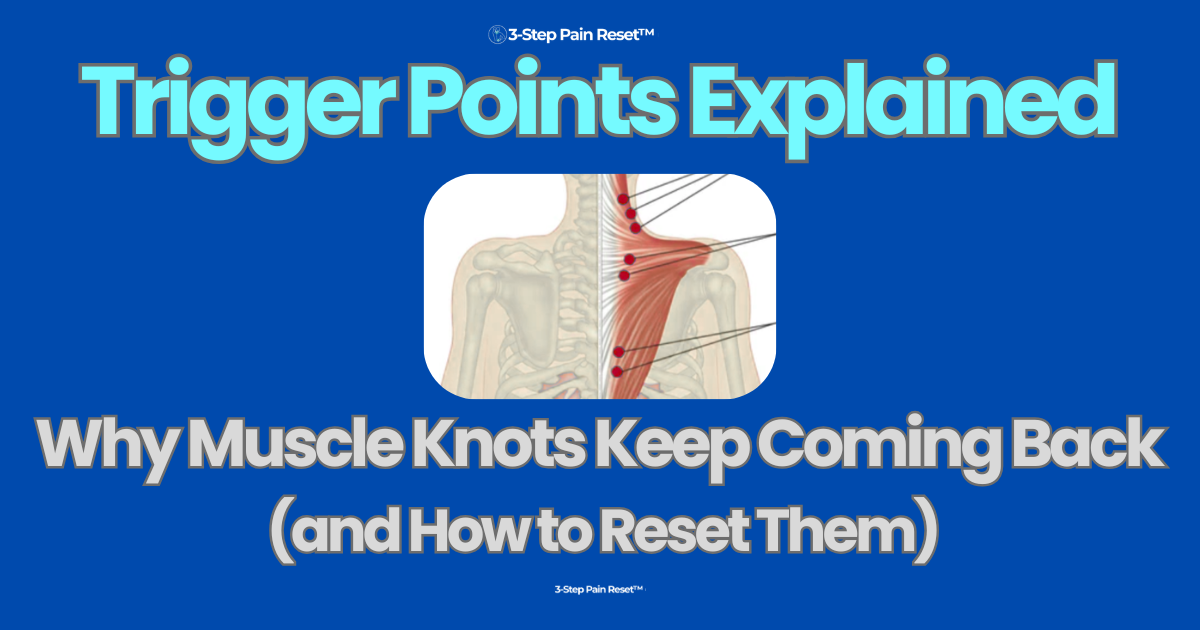
Trigger points are tight, sensitive spots within muscle tissue — commonly called “knots.” They form when muscles stop cycling properly between contraction and relaxation, leaving bands of tissue locked in place. The pain you feel from a trigger point often isn’t coming from where you think it is.
Most people try stretching or temporary pressure relief, and the knot comes back within days. That’s because they’re treating the symptom — not the pattern behind it.
Why Trigger Points Form
Trigger points are a response to repeated stress, not random events. The same patterns create them over and over:
The 3-Step Pain Reset™
Stop treating symptoms. Reset the pattern that keeps creating them.
The same neuromuscular method used in clinical settings — simplified for home use. Release → Moist Heat → Stretch. Done in order. Takes 15–20 minutes.
Repetitive Motion
Desk work, driving, and repetitive exercise train the muscle into a fixed contraction pattern. Over time that becomes its resting state.
Poor Posture and Positioning
Forward head posture, rounded shoulders, and prolonged sitting create uneven load — some muscles chronically shortened, others overstretched. Both create trigger points.
Overuse Without Recovery
Exercise or activity that doesn’t allow proper recovery leaves muscles in a partially contracted state. Tension accumulates until it becomes a constant ache.
Stress and Guarding
Physical or mental stress causes the nervous system to hold muscles in a braced, protective state. This guarding often outlasts the original stressor significantly.
What Trigger Points Feel Like
- Deep, aching sensation — not sharp
- Tender or painful when pressed directly
- Tightness that doesn’t fully release on its own
- Pain that spreads or refers to nearby areas
- The same spot keeps tightening after temporary relief
According to the Cleveland Clinic, trigger points require more than passive stretching to fully resolve — the underlying contraction pattern must be interrupted first.
Why They Keep Coming Back — A Comparison
The approach you use determines whether you get temporary relief or lasting change:
| Approach | What Happens | Result |
|---|---|---|
| Stretch first | Muscle resists — it’s still guarding | Temporary at best |
| Aggressive pressure | Body protects harder — more guarding | Pain returns faster |
| Random heat | Warms surface only, pattern unchanged | Feels good, doesn’t fix it |
| Release → Heat → Stretch | Pattern interrupted, tissue receptive | Lasting relief |
The Correct Sequence
The 3-Step Pain Reset Sequence
Most Affected Areas
Need the right tools to interrupt the trigger point pattern?
Simple at-home tools used in the 3-Step sequence.Related Posts
Get the Free Pain Reset Guide
The exact breakdown of the trigger point sequence — free instant download with pain area guides and a 7-day plan.
Get the Free Guide →Trigger points are not random. They’re a response to repeated stress and patterns that haven’t been reset. Stretching alone won’t fix them. The right sequence — in the right order — makes all the difference.
Want the Full 10-Page System?
Complete guide with trigger point breakdowns by area, 7-day plan, daily routine card, and bonus app. $9.97 — instant download.