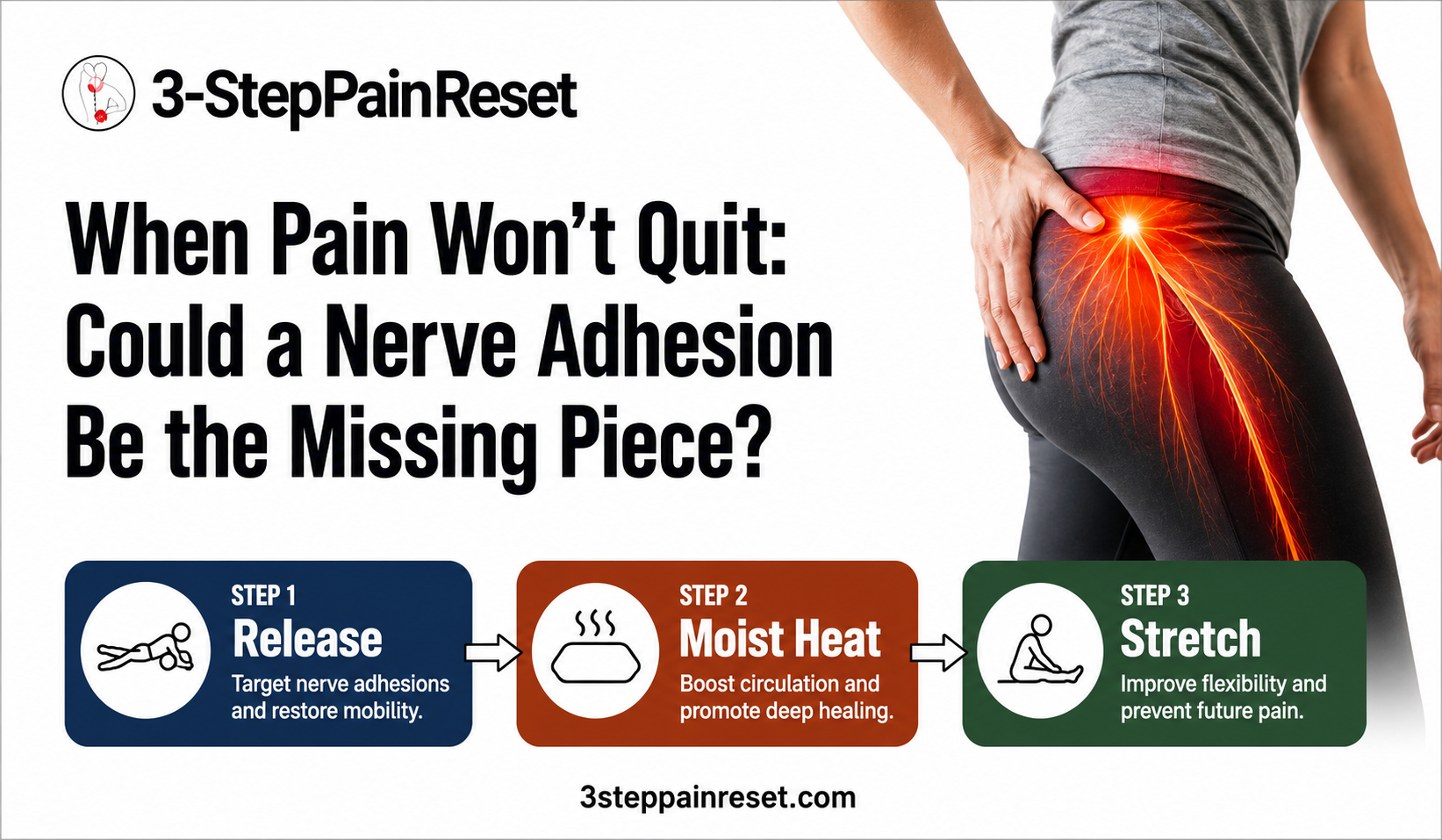
When Pain Won’t Quit: Could a Nerve Adhesion Be the Missing Piece?
If you have nerve adhesion hip pain — stretching the same area for months with nothing changing, or leg pain that keeps cycling back no matter what you try — there is a possibility most people never consider: the nerve itself may be stuck.
Not weak. Not inflamed. Stuck.
As a neuromuscular therapy specialist with 15 years of clinical experience, I’ve worked with hundreds of patients who were doing everything right — stretching, strengthening, applying heat — and still hurting. In many of those cases, the real problem wasn’t the muscle at all. It was a nerve adhesion quietly anchoring everything in place and driving pain that no amount of self-treatment would fully break.
The 3-Step Pain Reset™
Stop treating symptoms. Reset the pattern that keeps creating them.
The same neuromuscular method used in clinical settings — simplified for home use. Release → Moist Heat → Stretch. Done in order. Takes 15–20 minutes.
This post walks you through what nerve adhesions are, how they drive two of the most stubborn pain patterns I see in practice — deep hip pain and outer buttock/leg pain — and what it actually takes to resolve them, in the office and at home.
What Is Nerve Adhesion Hip Pain?
A nerve adhesion happens when a peripheral nerve becomes bound to the surrounding connective tissue — usually following injury, repetitive strain, or prolonged compression. The nerve loses its ability to glide freely as you move. That restriction creates tension, irritation, and often referred pain that travels far from the actual problem site.
This is different from nerve compression (like a herniated disc pressing on a nerve root). An adhesion is a binding. The nerve can still function, but it cannot move without pulling on the tissue around it. That constant pull keeps the pain cycling and never fully resolving.
For a deeper look at how peripheral nerve pain behaves and why it is so often misdiagnosed, Spine-Health’s guide on exercise and sciatica is a solid starting point.
The two nerve adhesion patterns I see most often clinically involve the femoral nerve in the psoas and the sciatic nerve at the piriformis.
Femoral Nerve Adhesion: Hip Pain Deep in the Psoas
The femoral nerve runs through and alongside the psoas major — the deep hip flexor that connects your lumbar spine to your femur. When the psoas becomes chronically tight or develops dense trigger points, the femoral nerve can become restricted in that tunnel of muscle and fascia.
The result? Pain or aching in the front of the hip, inner thigh, or groin. Sometimes a strange weakness when lifting the knee. Sometimes deep pelvic discomfort with no clear imaging finding to explain it.
If you’ve been sitting long hours and dealing with hip pain that just won’t resolve, a femoral nerve adhesion in the psoas is worth having evaluated by a neuromuscular specialist. This does not show up on X-ray or MRI. It shows up in the tissue under a trained hand.
Sciatic Nerve Adhesion: The Piriformis Connection
This one is more commonly discussed — and frequently misunderstood.
The piriformis is a small, deep external rotator of the hip that sits directly over the sciatic nerve. In some people, the sciatic nerve actually passes through the piriformis muscle. When the piriformis develops significant trigger point activity or thickening, it can create a sciatic nerve adhesion — binding the nerve against the surrounding tissue and producing pain that radiates well beyond the hip.
The pain pattern: deep buttock aching, pain that refers down the back of the thigh, and sometimes tingling or numbness into the calf or foot. These symptoms look a lot like disc-related sciatica — but they don’t respond to spinal treatment because the spine isn’t the problem. The adhesion is.
Watch this short video for a closer look at how the piriformis traps the sciatic nerve and drives this pattern:
How the piriformis creates sciatic nerve adhesion and hip pain — and what to do about it.
How Neuromuscular Therapy Releases a Nerve Adhesion
This is where technique matters — and it’s important to be precise, because this is not a self-treatment. The passive movement involved must be controlled entirely by the therapist to be both safe and effective.
In the office, I combine sustained ischemic compression on the trigger point with passive movement of the limb to lengthen the nerve through the restricted tissue. The patient is positioned side-lying, which allows the hip and leg to move freely while I maintain specific pressure directly on the nerve adhesion site.
Sciatic nerve adhesion — piriformis release:
With the patient side-lying and the hip in a controlled position, I passively move the leg — extending, internally rotating, or applying gentle traction — while sustained pressure on the piriformis encourages the sciatic nerve to slide rather than drag. The patient does not push, resist, or assist. That’s intentional. Active contraction at the wrong moment can reinforce the adhesion rather than release it.
Femoral nerve adhesion — psoas release:
Similar principle, different positioning. Side-lying with the hip in extension, I work into the psoas while moving the leg through positions that encourage femoral nerve glide through the shortened tissue. Passive movement only, guided entirely by what the therapist feels the tissue doing in real time.
These techniques require a trained hand, anatomical knowledge, and the ability to read tissue response moment to moment. They cannot be safely replicated from a video.
📍 In the Phoenix area? Reach out to schedule a neuromuscular evaluation: support@3steppainreset.com
After the Adhesion Releases: The 3-Step Continuing Care Plan
This is the part most people miss — and it is why pain returns even after a successful office visit.
When a nerve adhesion releases, the surrounding muscle tissue is still holding patterns it has maintained for months or years. Trigger points remain active. The tissue is sensitized. Return to the same posture and daily routine without structured follow-up, and the adhesion often re-forms within weeks.
This is exactly why I built the 3 Step Pain Reset process — as continuing care for after the adhesion has been cleared in the office.
The 3-Step Sequence for Lasting Relief
- Release — Targeted self-pressure on the residual trigger point to keep the tissue decompressed and prevent re-binding between sessions.
- Moist Heat — Approximately 10 minutes of moist (not dry) heat to increase circulation and allow the tissue to soften and reset after release.
- Stretch & Rebuild — Gentle, progressive movement to restore normal range of motion and retrain the muscle before old compensation patterns reset.
This sequence is done after the nerve adhesion is addressed in the office — not as a substitute for it. It’s what makes the professional work hold.
Get the Full Protocol
If you want the complete method laid out step by step — including how to apply it for hip, sciatic, and referred pain patterns — you have two options:
The free guide gives you the overview and a solid starting point. The complete guide walks through the full protocol with detailed instructions and correct sequencing for nerve-related pain patterns.
The Right Tools for Home Care
Effective home care after nerve adhesion treatment requires the right equipment. A tennis ball won’t reach these structures, and most standard foam rollers don’t target them accurately. I’ve put together a list of the specific tools I recommend to my own patients for self-care between sessions.
🔧 See the recommended therapy tools →
Follow Along for More
I post short educational videos on nerve pain, trigger points, and why chronic pain keeps coming back — on YouTube and Facebook. If this post resonated, these are good places to keep learning between sessions:
The bottom line: Chronic hip and sciatic pain that does not respond to stretching, strengthening, or chiropractic care may not be a muscle problem at all. Nerve adhesion hip pain — whether at the psoas/femoral nerve junction or the piriformis/sciatic nerve — can lock the entire system in a cycle that self-treatment alone will not break.
Neuromuscular therapy, specifically passive nerve glide techniques performed by a trained specialist, can release these adhesions in one or several office visits. After that, the 3 Step Pain Reset process is how you protect that result and prevent the pattern from returning.
You don’t have to keep living in that cycle.