Referred pain and compensation are two major reasons pain keeps moving from one area to another. You treat your neck for a week and it improves — then the headaches start. You fix the headaches and your shoulder starts acting up. You work on the shoulder and the pain moves to your upper back. If this sounds familiar, your pain isn’t spreading randomly. It’s following a pattern — and it’s why pain keeps coming back no matter what you treat.
Understanding referred pain and compensation is the single biggest shift most people make when they stop chasing symptoms and start actually resolving them.
What Is Referred Pain and Compensation?
Referred pain is pain felt in a location that is different from where the source of the problem actually is. It happens because the brain processes pain signals from multiple areas through the same neural pathways — and sometimes attributes pain to the wrong location entirely.
The 3-Step Pain Reset™
Stop treating symptoms. Reset the pattern that keeps creating them.
The same neuromuscular method used in clinical settings — simplified for home use. Release → Moist Heat → Stretch. Done in order. Takes 15–20 minutes.
Trigger points — those tight knotted spots in muscle tissue — are one of the most common sources of referred pain. The trigger point itself may feel only mildly tender, but it sends pain signals to an entirely different area of the body.
According to Cleveland Clinic, trigger points can cause referred pain in areas far from the actual source — which is why so many people treat the wrong location for months.
Classic Referred Pain Patterns
These are some of the most commonly misunderstood examples — people treat the pain location for months while the real source goes untouched:
Upper trapezius trigger point → tension headaches, side of head, behind the eye
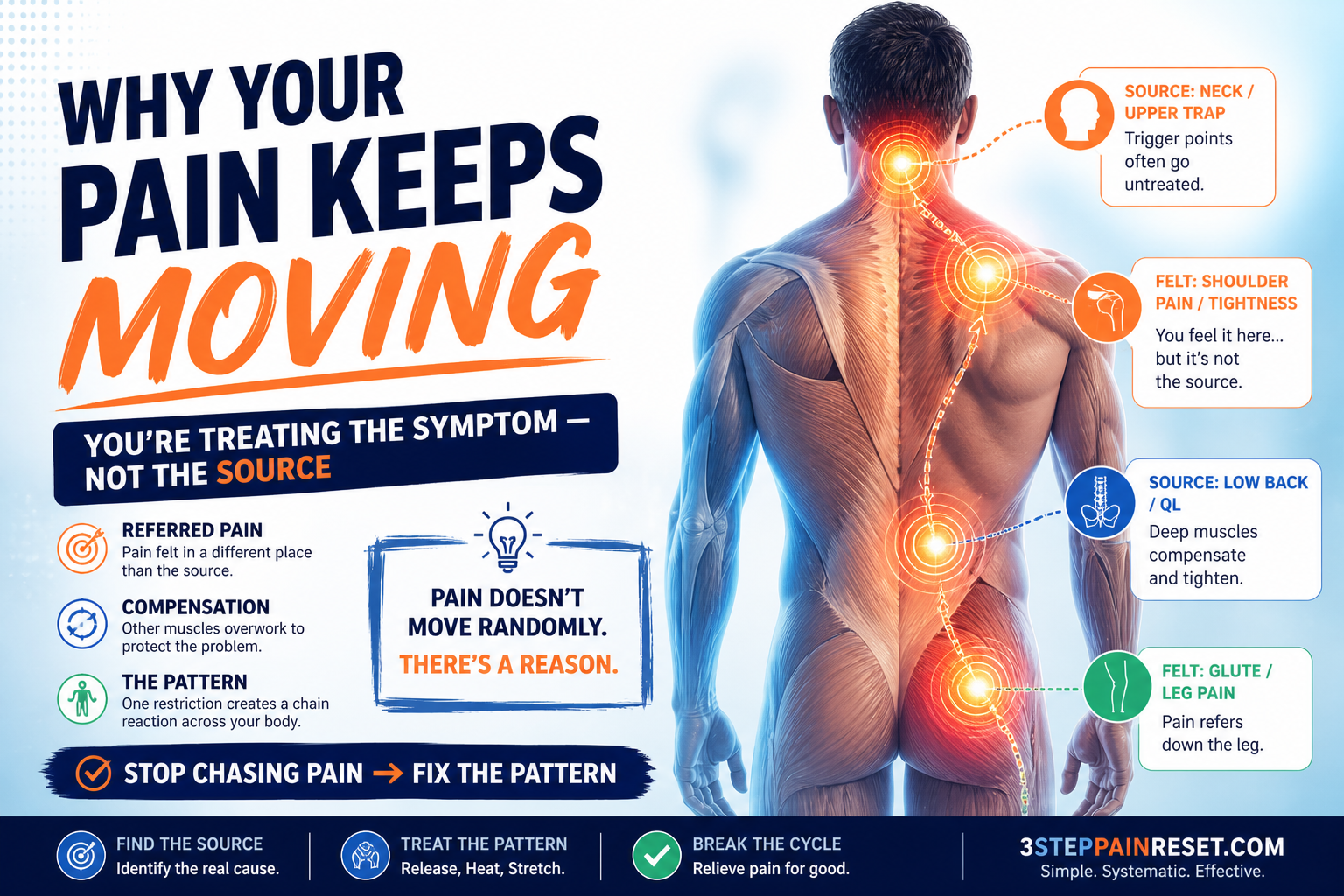
Referred Pain and Compensation Map — Source vs. Where You Feel It
This is why treating “where it hurts” so often fails. With referred pain and compensation, the pain location and the pain source are frequently different places:
What Is Compensation — And Why Pain Moves
Compensation is different from referred pain. It happens when one area of the body is restricted or painful, so neighboring muscles take on extra load to protect it. Over time those compensating muscles develop their own trigger points and pain — and suddenly you have pain in a new location.
The Compensation Chain — How Pain Travels
Tight hip flexor → hip doesn’t extend fully → low back compensates by hyperextending → low back tightens → upper back compensates to maintain balance → upper back develops trigger points → neck tightens to stabilize → headaches begin. One original restriction creates a chain reaction across the entire body.
Breaking the Chain — Work the Pattern, Not the Symptom
When you treat the original restriction — the hip flexor in this example — the entire chain has a chance to unwind. The low back stops compensating. The upper back releases. The neck relaxes. This is why systematic treatment of the full pattern beats chasing individual pain spots every time.
Chasing Pain vs. Treating the Referred Pain Pattern
| Approach | Chasing the Pain Location | Treating the Pattern |
|---|---|---|
| Focus area | Where it hurts right now | Where the source restriction is |
| Result after treatment | Relief in that spot, pain moves elsewhere | Pain reduces at source and referred location |
| Long-term outcome | Endless cycle of new pain areas | Systematic reduction as chain unwinds |
| Time to results | Temporary — days to weeks | Cumulative — builds week over week |
How to Apply This With the 3-Step Method
The 3-step sequence — Release, Moist Heat, Stretch — works best when applied systematically rather than just to the loudest pain area. For referred pain and compensation, the goal is to work the pattern instead of only treating the loudest symptom. Here’s how to think about it:
Apply the sequence systematically — not just where it hurts
If you have neck pain and headaches, work the upper trap and suboccipital area — not just the head. If you have low back pain, include the hip flexors and glutes — not just the lumbar muscles. The full guide breaks this down by pain area so you know exactly where to apply the sequence for each pattern. See also: what trigger points are and why they refer pain and why the tension pattern keeps rebuilding.
Tools to work the full pattern at home
Massage balls and moist heat for systematic release across areas.Related Posts
Get the Free Pain Reset Guide
Includes pain area breakdowns by location — so you know where to apply the sequence for each pattern. Free instant download.
Get the Free Guide →Pain that keeps moving is not a mystery — it’s a system. Referred pain and compensation explain why the loudest spot is not always the original source. Treat the source, not the symptom. Work the pattern, not the loudest spot. When you understand the chain, you stop chasing and start resolving.
Want the Full 10-Page System?
Complete guide with pain area pattern breakdowns, 7-day plan, daily routine card, and bonus app. $9.97 — instant download.