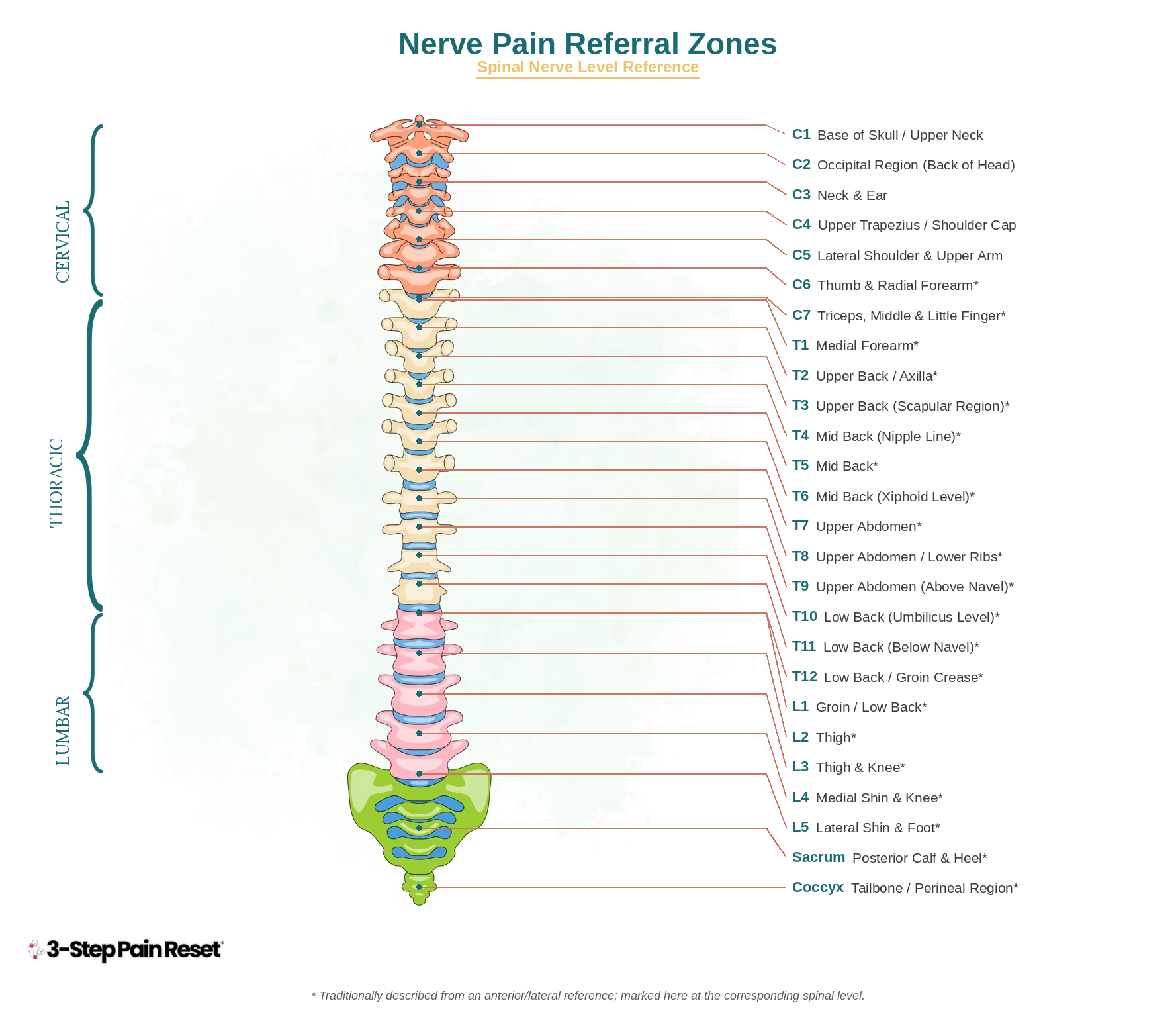
Numbness that runs down your arm to your thumb. A burning line down the outside of your shin. Pain that starts in your low back and shows up in your calf, nowhere near where it actually started. If a symptom feels like it’s traveling — following a line down a limb instead of staying in one spot — you’re not imagining it. That’s how nerve referral pain works, and it follows a map.
That map is called a dermatome — a strip of skin supplied by a single spinal nerve. When a nerve root gets irritated at the spine, the pain, tingling, or numbness doesn’t stay at the spine. It travels the length of that dermatome, sometimes all the way to a finger or a toe.
Nerve Referral Pain vs. Muscle Referred Pain — What’s the Difference?
We’ve covered how a tight trigger point refers pain to a different area — that’s a muscle-to-muscle signal. Nerve referral pain is different: it follows an actual spinal nerve root, not a muscle pattern, which is why it tends to feel different too.
The 3-Step Pain Reset™
Stop treating symptoms. Reset the pattern that keeps creating them.
The same neuromuscular method used in clinical settings — simplified for home use. Release → Moist Heat → Stretch. Done in order. Takes 15–20 minutes.
Muscle Referred Pain
Dull, achy, deep. Stays in a general region — shoulder blade, hip, temple.
Nerve Referral Pain
Sharper, or electric. Often includes tingling or numbness. Travels in a line, not a region.
How Nerve Referral Pain Actually Works
Each spinal nerve root exits between two vertebrae and supplies sensation to a specific strip of skin — its dermatome. When that nerve root is compressed or irritated, your brain reads the signal as coming from anywhere along that strip, not just at the spine. That’s why a neck-level nerve can produce numbness in a single finger, and a low-back-level nerve can produce pain that runs past the knee into the foot.
Common Nerve Referral Patterns
These are the patterns people run into most — and most people never connect them back to the spine:
C6 Nerve Root
Neck → thumb and outer forearm — often mistaken for wrist strain
C7 Nerve Root
Neck → triceps and middle finger — often mistaken for elbow or tendon pain
L4–L5 Nerve Root
Low back → outer shin and top of the foot — classic sciatica pattern
S1 Nerve Root
Low back → back of the leg to the heel — often mistaken for calf strain
If any of these sound familiar, the full dermatome and nerve level reference maps every spinal level to where it refers.
When It’s Actually a Tight Muscle Pinching the Nerve
Nerve referral pain sounds alarming, and sometimes it needs a doctor’s attention. But very often, the nerve itself isn’t damaged — it’s being compressed by a tight muscle sitting right on top of it. Two of the most common examples:
- Piriformis on the sciatic nerve — a tight piriformis in the deep glute can compress the sciatic nerve as it passes underneath, producing pain that runs down the leg exactly like a disc issue.
- Scalenes and pec minor on the brachial plexus — tight neck and chest muscles can compress the nerve bundle feeding the arm, producing tingling into the hand that has nothing to do with the neck bones themselves.
In these cases, releasing the muscle that’s compressing the nerve is often what actually resolves the symptom — which is why the 3-step sequence still applies here.
Nerve Referral vs. True Radiculopathy — Know the Difference
| Muscle Compressing a Nerve | True Nerve Root Injury (Radiculopathy) | |
|---|---|---|
| Onset | Gradual, tied to posture or repetitive strain | Often sudden, sometimes after a specific injury |
| Symptoms | Tingling, referred ache, comes and goes | Persistent numbness, progressive weakness |
| Responds to | Release → Moist Heat → Stretch | Needs medical evaluation |
| What to do | Apply the sequence to the compressing muscle | See a physician before self-treating |
How to Apply the 3-Step Method to Nerve Referral Patterns
Apply the sequence to the muscle likely compressing the nerve — not just the area where you feel the symptom:
For a sciatic-pattern leg symptom, work the piriformis and deep glute — not just the calf where it burns. For a hand or forearm symptom from the neck, work the scalenes and upper trap — not just the wrist. The full guide breaks down exactly where to apply the sequence for each nerve pattern.
Massage balls and moist heat to release the muscle sitting on the nerve.
View Tools →Related Posts
Includes pain area breakdowns by location — so you know where to apply the sequence when a symptom is traveling. Free instant download.
Get the Free Guide →Nerve pain that travels isn’t random — it’s following a map your body has had all along. Understanding that map is the difference between chasing a symptom down your arm or leg and actually treating what’s causing it.
Want the Full 10-Page System?
Complete guide with pain area pattern breakdowns, 7-day plan, daily routine card, and bonus app. $9.97 — instant download.
Get the Guide + App →