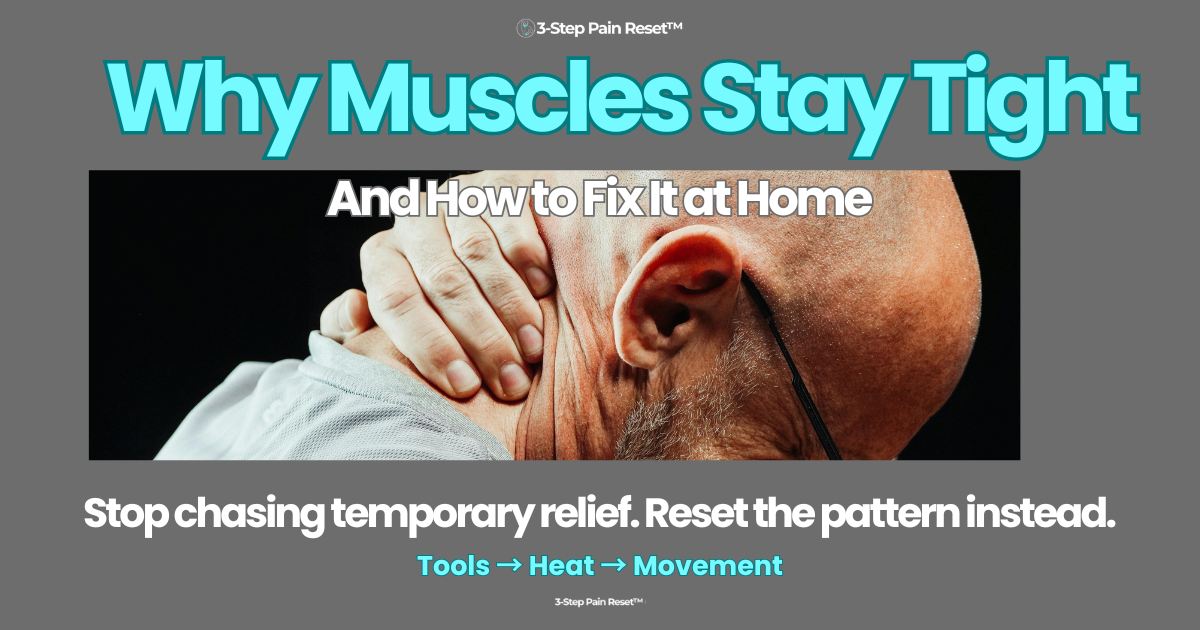
Muscles are designed to contract and relax. When that cycle gets stuck — from repetitive motion, stress, or poor positioning — tightness builds and stays. The common fix most people try is more stretching. But stretching alone rarely fixes the problem.
If you’ve already read about trigger points and muscle knots, you know these tight areas are part of a larger pattern — not just isolated spots. Here’s what actually keeps them locked and how to break the cycle.
Why Muscles Stay Tight
Muscles don’t stay tight randomly. They tighten in response to repeated stress and stay locked when the underlying pattern hasn’t been reset. The most common triggers:
The 3-Step Pain Reset™
Stop treating symptoms. Reset the pattern that keeps creating them.
The same neuromuscular method used in clinical settings — simplified for home use. Release → Moist Heat → Stretch. Done in order. Takes 15–20 minutes.
Repetitive Motion
Desk work, driving, and repetitive workouts train muscles into fixed patterns. Over time those patterns become the resting state — tense by default.
Poor Positioning
Forward head posture, rounded shoulders, and prolonged sitting all create unequal load on muscles. Some are chronically shortened, others chronically lengthened — both result in pain.
Overuse Without Recovery
Exercise without proper sequenced recovery leaves muscles in a partially contracted state. The tension accumulates until it becomes a constant background ache.
Protective Guarding
After any pain signal — even minor — your nervous system guards the area by keeping surrounding muscles contracted. This guarding often outlasts the original issue by weeks or months.
Why Stretching Alone Doesn’t Fix It
Stretching feels like the right answer. But tight muscles are usually stuck in a protective or overactive state. Until that pattern is interrupted at the source, the muscle tightens again shortly after stretching — sometimes immediately.
Stretching treats the symptom, not the cause. The muscle is guarding for a reason. Pulling it longer before releasing that guard often makes it contract harder — which is why so many people feel relief during a stretch and then feel worse the next morning.
The Missing Piece — Sequence
What most people miss isn’t a technique — it’s the order. Tight muscles respond to a specific sequence. Do things in the wrong order and you get temporary relief at best. Do them in the right order and the pattern actually resets.
Most people try things randomly: stretch first, use heat if they remember, apply pressure with whatever’s nearby. The sequence below is what changes the outcome.
The 3-Step Pain Reset Sequence
Release — Interrupt the Pattern
Use a massage ball or similar tool to apply gentle, sustained pressure to the tight area. This signals the nervous system to stop guarding. No aggressive digging — gentle hold is enough.
Goal: Interrupt the tension cycle before anything else
Moist Heat — Reinforce Relaxation
Apply moist heat after tool work while the muscle is in a more receptive state. Heat increases blood flow, flushes waste products, and locks in the release you just created.
Goal: Deepen the release and prepare for movement
Stretch — Restore Length
Only now — after the muscle has released and warmed — does stretching become effective. The muscle is no longer guarding, so it accepts length instead of resisting it.
Goal: Restore natural range and prevent re-tightening
Where Muscles Stay Tight Most Often
These areas are most commonly affected by repetitive motion and daily positioning habits — and respond well to the sequence above:
Need the right tools for Step 1?
Simple at-home tools that make the release step actually work.Related Posts
Get the Free Pain Reset Guide
The exact step-by-step breakdown — with pain area guides, a 7-day plan, and daily routine card. Free instant download.
Get the Free Guide →Muscles don’t stay tight by accident. They tighten in response to repeated stress and stay locked when the pattern hasn’t been reset. Stretching alone won’t fix it. Random approaches won’t fix it. The right sequence makes the difference.
Want the Full 10-Page System?
Complete step-by-step guide with pain area breakdowns, 7-day plan, daily routine card, and bonus app. $9.97 — instant download.